

I’ve spent my entire ministry in the world of starting new churches. After graduating from Pittsburgh Theological Seminary, I jumped right into the hard work of starting a new church, and I did that work for nine years. I’ve since spent another nine years supporting church planters across the country through the Presbyterian Church (USA)’s 1001 New Worshiping Communities initiative.
Recently in 1001, we hired a researcher to interview 20 new worshiping community leaders who have been doing this entrepreneurial work for at least five years. These are the leaders who have shown a fair amount of resilience in the hard work of church planting, whose concepts of new churches have moved from idea to actualized community, and who have survived the challenging initial years showing proof-of-concept.

The interviews revealed a pattern that was as unsurprising as it was inconvenient. Among those interviewed, leaders who embraced fundraising early generally appeared more resilient and sustainable over time. The new worshiping community leaders who were late adopters to the work of fundraising, or who remain resistant to that part of the work, are struggling.
The finding seems obvious. Any new ministry or any new endeavor costs money. And so, of course, the founder will need to acquire the resources necessary to bring their vision to life. Indeed, any ministry, regardless of its age, needs resources to function. And yet, most of us in church leadership, entrepreneurial or otherwise, resist the notion that we need to act as fundraisers. Where does this resistance come from?
Common Concerns About Fundraising
One category of objections that I hear might be called the principled stand. We are doing ministry in the context of an unjust system. We resist the notion that our ministries should be judged by or dependent upon a capitalist system that reduces the value of others to the amount of money they can give. We resist the notion that the value of our ministry should be determined by the amount of dollars it can raise. These concerns are valid. And yet they don’t excuse us from the work of fundraising. Systemic problems related to money can be changed and fixed, but changing them will be a long-term process. The work of fundraising addresses more urgent needs. Before we’re able to build a viable alternative to late-stage capitalism, the church’s boiler will need to be repaired and the pastor will need a paycheck.
Other common objections to fundraising are rooted in fear. As ministry leaders, we have a very real—and very human—fear of being rejected. The thought of asking for resources, whether from an individual, a congregation, or a grant-making organization, and then being told “no,” weighs on us heavily.
Fundraising Brings Interdependence
 At least one new worshiping community leader interviewed in our research, however, offered a blunt assessment: “You need to get over the discomfort of talking about money. And start talking to people about money, and start talking to people who have money about how they should be investing [it] in your ministry.”
While fear of rejection receives most of our attention, I also wonder whether some ministry leaders are equally afraid of success. Raising enough support to sustain a ministry means acknowledging our dependence on others. It creates accountability. It invites partnership. For some leaders, especially those who deeply love their work, it may also create discomfort around being paid to do something that feels more like a calling than employment.
Many leaders are also concerned about the dynamic of making more money than their parishioners. The thought of raising enough money for our ministry and staff salaries to be fully funded might come with questions: What if receiving support creates obligations with which we’re uncomfortable? What if asking for financial gifts forces us to admit that we need others? What if generosity creates interdependence? What if accepting financial support means allowing others to shape the ministry’s future?
An Ecosystem of Mutual Support
So, what are we learning?
Another important finding from the survey was that the most successful new worshiping community leaders have developed diversified income streams for their communities. Flourishing new churches are supported by individual contributors (participants and outside donors alike); side ventures such as coffee shops, paddleboard shops, and other entrepreneurial endeavors; community fundraisers; grants from denominations, judicatories, and other foundations; and the support of partnering churches.

This suggests to us that the sustainability of any church or ministry is not only about raising enough money to meet the budget, but rather about building an entire ecosystem of mutual support. New churches need the support—financial and otherwise—of legacy churches in their communities. Legacy churches, in turn, need the vitality and energy that new worshiping communities can bring to their neighborhoods and ministries. Sustainable ministries do not thrive because they find one large source of money; they thrive because they become embedded in networks of mutual support.
One of the most striking findings in our research concerned the role of presbyteries. No leader was neutral. Some described their presbytery as an indispensable source of encouragement, partnership, and support. Others described significant obstacles. Their strong reactions underscored this larger truth: churches and ministries do not thrive in isolation. Sustainability depends on the health of the wider ecosystem in which a ministry operates.
Connection Sustains the Whole Ecosystem
And so, there’s a theological root beneath what our interviewees shared and beneath the need to fund our ministries. Stewardship is not really about the sustainability of one congregation or ministry but about the sustainability of an ecosystem of churches and ministries flourishing together. Asking for money doesn’t just bring financial contributions; the act of asking becomes a web that connects our churches and ministries with other parts of the ecosystem. And so, it’s not just about asking; it’s about connecting and offering partnership.

The good news is that abundance is not reserved for ministries that begin with full bank accounts. The possibility of asking, connecting, and offering partnership is always before us. Each invitation we extend strengthens the larger ecosystem of churches and ministries that make up the Body of Christ. What may appear at first to be empty nets may in fact be God’s invitation to discover how deeply we depend upon one another.
Stewardship, then, is not simply the work of securing resources. It is the work of connecting people, congregations, and ministries to a shared mission. Every invitation to give is also an invitation to participate. Every act of generosity strengthens the web of relationships that makes ministry possible. In that sense, asking is never just asking; it is extending an offer of partnership in the work God is already doing among us.
To gain theological and practical fundraising skills, we invite you to attend the 2026 Henderson Lecture and Leadership Conference:
From Empty Nets to Overflowing Impact: Discovering God’s Abundance Through Stewardship
With the Rev. Dr. Sidney S. Williams Jr., Nov. 17-18, In-person and Online
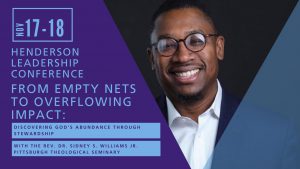
In a time when many congregations are navigating financial strain, shifting demographics, and urgent community needs, this lecture invites faith leaders to move beyond scarcity thinking and recover a theology of abundance rooted in the gospel. Drawing from Fishing Differently, the Rev. Dr. Sidney S. Williams Jr. will explore how churches can reimagine stewardship, leverage sacred assets, and build sustainable models for social impact. The lecture will challenge leaders to see fundraising not merely as a financial necessity, but as a spiritual practice of aligning resources with mission, cultivating community partnerships, and participating in God’s work of transformation.
Register here for the free public lecture or the full conference (in-person or online)

The Rev. Michael Gehrling, ’08 is manager of the PC(USA)’s 1001 New Worshiping Communities with Presbyterian Life and Witness. In this role, he walks alongside innovative leaders as they discern the new things God is calling them and the church to create together and aids presbyteries and worshiping communities in developing faithful practices to cultivate innovation among their people. Michael is co-editor of and contributing author to Sustaining Grace: Innovative Ecosystems for New Faith Communities. He is a certified Clifton Strengths coach with Gallup and a certified conflict manager with Kilmann Diagnostics.