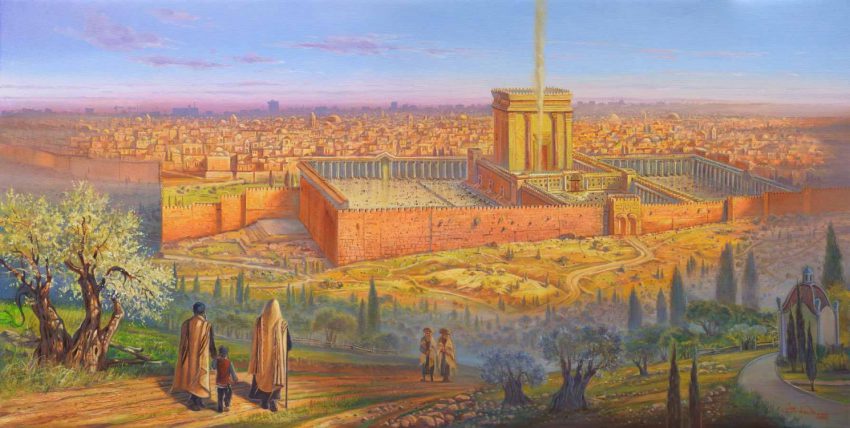

Above: Painting by Alex Levin: “Smoke Pillar arising from Jerusalem Temple”; https://artlevin.com/
On Nov. 6, 2025, Dr. Tucker S. Ferda was installed into the Errett M. Grable Chair of New Testament Exegesis and Early Christianity at Pittsburgh Theological Seminary. Below are concluding remarks from his inaugural lecture, “The Solidarity of the Messiah: Recovering Matthew’s Theology of the Cross within Second Temple Judaism.”
Errett M. Grable was born in 1889 in Hiram, Ohio, and graduated from Stetson University in 1909. President of Weaver Aluminum Inc., a subsidiary of Aluminum Company of America, Grable later became the founder and lifetime director of Rubbermaid Inc., which grew into an international housewares manufacturing company. A member of the board of directors of Western Theological Seminary, he played a major role in guiding the merger between Western Theological Seminary and Pittsburgh-Xenia Seminary to form Pittsburgh Theological Seminary. The chair was established by Minnie K. Grable in 1964 in memory of her husband. In 1970 Dr. Markus Barth was named as its first occupant, and in 1979 Dr. Ulrich Mauser was named as its second occupant. Dr. Dale C. Allison Jr. was installed in 2000 as its third occupant, and Dr. Tucker S. Ferda was installed in 2025 as its fourth occupant.
A Call to Participate in Jesus’ Story
In my view, we can’t say much concretely about Matthew’s original audience. But we can say with confidence that whoever wrote this thing, and whomever exactly they were writing for, it had a purpose that is not completely unfamiliar to religious readers today. There is some wisdom in the emerging consensus view that the Gospels are a species of ancient biography, and that matters because ancient biographies weren’t written merely to satisfy historical curiosities but to encourage their readers to imitate the virtues of the main character. Matthew’s story of the solidarity of the Messiah is a story that intends to describe the character of God and God’s power to save, to be sure, but it also, at the same time, seeks to invite the participation of the readers and to stimulate their moral imagination. It is obvious that the readers’ imitation of Jesus would not be exactly identical in a new time and space, but such is precisely the power of narrative and why it speaks in fresh ways to each successive generation. This reminds me of one of the more fascinating things I found in our archive from Markus Barth’s old files: a handout he used to give his students titled, “What is an Exegesis.” In it, near the end, he wrote: “The Bible is already interpretation; so do not add to it, but participate in it.”
Matthew’s Gospel, for its part, encourages the readers to wonder how they might, in their own time and way, participate in the work of the one who came to “be with.” This is not merely implicit in the narrative; it is explicit, in the Gospel’s final parable from Jesus. Jesus tells his followers where they might find him: “I was in prison.” “I was hungry.” “I was thirsty.” “I was a stranger.” “I was naked.” “Whatever you do for the least of these, you do it for me” (25:40). We are left with the impression that the one who entered history in the wreckage of the exile continues to be found in the exilic spaces of the world, and encourages his followers to be there, too.
In this way, Matthew presents a challenge to theological education today. With all the difficulties facing the church and society at large, with the sense of despair many feel on all sides, with social and economic and technological challenges that seem at times insurmountable, and with the growing division and alienation many of us have with our neighbors, Jesus’ ministry of solidarity may model for us a way of being in the world. Theological educators I think are particularly susceptible to the temptation that we might think our way out of our challenges—that a new idea, or a new teaching approach, or a new method of biblical interpretation, or a new theoretical construct, might be the very thing that brings about the transformation we desire. But Jesus in Matthew did not teach his way out of the exile. The Gospel doesn’t claim that history changed because a new idea had entered the world. He did not fight his way out with the sword, and he didn’t retreat from the world to create his own group of the super-pious. Instead, the arc of the ministry of Jesus in Matthew, from infancy to death in Jerusalem, is a ministry of joining, of drawing closer to, of deep presence with, of sharing in all of the life of others. The teaching, the miracle working, the controversies and the debates, all occur within the larger movement of the solidarity of the Messiah. It is at the moment of his death, not at the conclusion of the teaching in the Sermon on the Mount, that the temple curtain is rent and the earth is shaken. In Matthew the power of the Gospel is the power that comes in and through the solidarity of Jesus to the bitter end. Paul will say that it is this power that disarms the principalities and the powers.
If I think more personally about my own role on the faculty here as a New Testament scholar, there is one other lesson from Matthew’s narrative to name. Matthew is of course for Christians Sacred Scripture, and therefore a source for theology and ethics. But as I’ve tried to show tonight, I believe Matthew is also an example of how we might engage in, as we like to say at PTS, “theologically reflective ministry.” This means doing theology not in a vacuum but from a particular place, allowing lived experience to raise new questions and to engage our traditions from there, which hopefully shapes our behavior and ultimately raises new questions. I have learned a tremendous deal about this dynamic from my teaching colleagues here, and from many of the initiatives at the Seminary, but also from the Gospels. Theologically reflective ministry is actually what made it possible for Matthew to be written in the first place; for Matthew’s theology of the cross is not an idea plucked from Scripture and dropped down into the first century. It is rather the product of living in a community, knowing a shared history, experiencing something that seemingly defies explanation, and returning to engage Scripture with fresh questions. This is precisely the sense, I think, of the blessing of Jesus, found only in Matthew, on “every scribe who has been discipled in the kingdom of heaven … like a person who brings out of a treasury things that are new, and things that are old” (13:52). As an exegete, this required Matthew not only to permit experience to teach and reveal, but to engage tradition with a trust and an openness that there may be more in what we have received that we have not yet fully understood. That, to me, is a profound lesson that Matthew, and messianic exegesis from the Second Temple period, might continue to offer the Church in the modern world: that there is a “more” there in our Sacred Writ, yet to be disclosed, that comes by entering more deeply in from where we are. If I can look back at the end of my career here and say that I strove at that, and invited students to do the same, then I will have been blessed to be, as Tennyson said, “a part of” the history of this chair and the great scholars who held it before me.
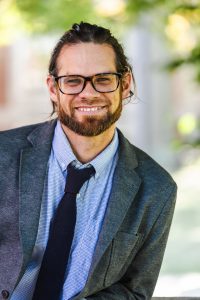 Dr. Tucker Samson Ferda is the Errett M. Grable Professor of New Testament Exegesis and Early Christianity. He has taught New Testament at PTS since 2013. Dr. Ferda has expertise in a wide range of areas in biblical studies, including the Gospels, the life of Jesus, the Old Testament in the New, the history of biblical interpretation, Hellenistic Jewish literature, the Dead Sea Scrolls, and the theological interpretation of Scripture. Many of these interests intersect in his first book, Jesus, the Gospels, and the Galilean Crisis (Bloomsbury T&T Clark, 2019), published in the Library of New Testament Studies series. His most recent book is Jesus and His Promised Second Coming: Jewish Eschatology and Christian Origins (Eerdmans, 2024). Dr. Ferda is a frequent presenter at regional and national SBL meetings, and he has published numerous essays and 20 peer-reviewed articles in top-tier biblical studies journals, including Journal of Biblical Literature, Journal of Theological Studies, New Testament Studies, and Journal for the Study of Judaism, among others. Dr. Ferda earned his Ph.D. from the University of Pittsburgh, where he also served as teaching fellow. In 2015, he was named a Regional Scholar of the Society of Biblical Literature, an award which “recognizes and promotes outstanding entry-level scholars.” Dr. Ferda is a member at Eastminster Presbyterian Church in Pittsburgh, and he frequently leads studies in area churches.