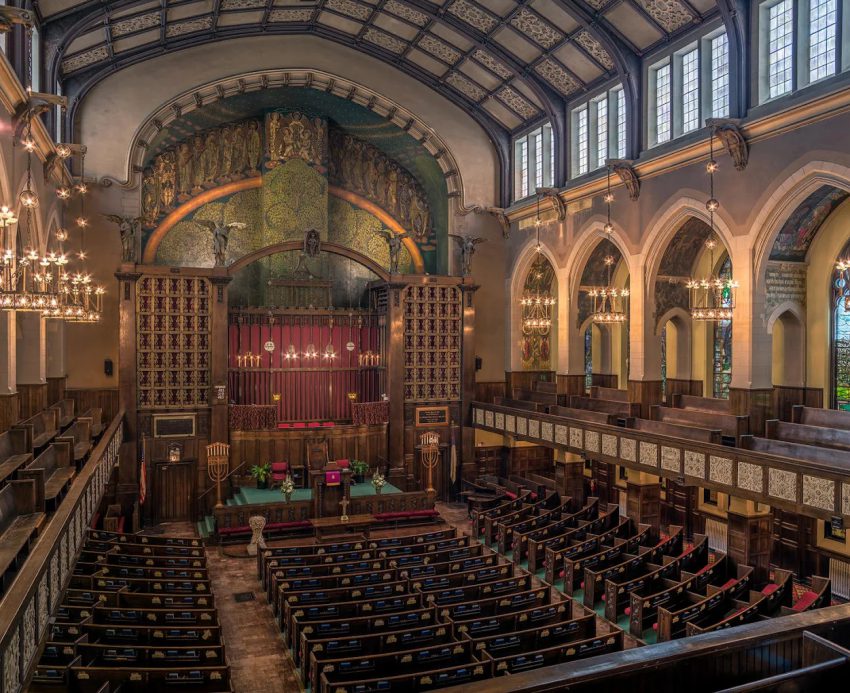

Above: interior of Second Presbyterian Church (Chicago, Ill.)
A few weeks ago, during a children’s message, I asked the kids to look around the room and find the plants. They turned in circles, spying carved motifs and the saturated colors of glass. After a moment, I pointed up. “Look up over my head,” I said, and watched as surprised delight bloomed on a crowd of little faces. Where many churches have a cross or a Christ Pantocrator, this one has a giant, sprawling mural of the Tree of Life, filling your eyes with leaves, stars, and angels. There are 175 angels hidden around this sanctuary—in flowers, pomegranates, rich red fabric, and gold and bronze metalwork. In the balcony, you can still walk on intricately woven runners from 1901. Above the baptismal font, carved from stone in a tangled mess of lilies, two lampstands flank the pulpit, from which the preacher looks directly at a window depicting the ascension.
A Ripple of Holiness
The sermon that day was about the tabernacle. As the people of Israel walked in the wilderness, they carried the tent of God’s presence around with them, along with the ark of the covenant. The pillar of fire and cloud rested on the ark and its tent, and lifted up to move when the God of Israel called the people to venture forward (Exod 40:36). In the tabernacle, and later, the temple in Jerusalem, God’s presence settled, creating a ripple of holiness in the real world, a separate, wholly other reality. The Torah relates that people of a creation in bondage to sin and death were in danger when this holiness was not handled rightly. How could they not be? The explosive collision of these realities, this apocalypsis of the living God, had shaken at the foundations of the natural world—an experience so terrifying that it could only be described as thunder, noise, smoke, and trembling, enrapt bodies (Exod 19:18). A mysterium tremendum et fascinans.1 Heavens and earth met here, in the holy of holies.
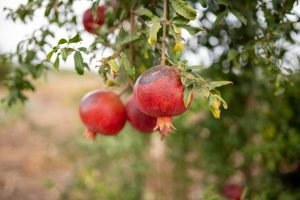 Once, this presence of heaven had not been a danger to anyone. And so the tent, and later the temple, were modeled on the heavenly throne room and the liturgical picture of a long-ago garden, a place where God walked among humankind and humankind was naked, completely and unashamedly vulnerable to a gracious Providence. The tent displayed intricate and carefully-planned beauty and crafts(wo)manship, with symbols of the garden and its Sabbath rest. Its liturgies of dedication spanned seven days, recalling (and perhaps involving) the poem at the beginning of the Torah.2 Later, the temple was filled with the most gorgeous and valuable resources of the natural world, worked in flowers, fruit, trees, and angels. Here, in a liturgical life that would shock most of us, they lifted praise to the Lord while offering life to sop up the contagion of death, curating a small place in this world where holiness could flood over a human being as it was meant to.
Abundance of Life
In the upcoming Schaff Lecture, Dr. Esther Chung-Kim will talk about 16th-century doctors who studied botany in the conviction that God had ordered the natural world in such a way that diseases could be cured. Advances in science have brought us down to the molecular, cellular, and microbiological in our quest for healing, and technology has allowed us to make inorganic interventions—titanium hips, for example. But the natural world and the laws that govern it are still the source of our ability to intervene. Materials still come from the chemical properties of the created world. What perhaps would have seemed like magic to early modern doctors is, in reality, a faraway point on a path they were walking already.
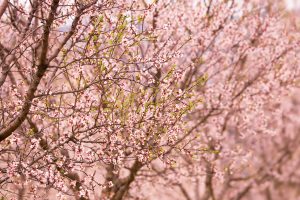 It struck me while studying the tabernacle that the liturgical images God chose to surround the sanctuary on earth were botanical. Gardens are places of flourishing biological activity, so much so that part of keeping a garden is reining in the exuberant press of life in weeds, bugs, and beautiful pests of all kinds. Gardens give life, as bees carry pollen from one place to another and animals eat fruit and carry seeds. Perhaps the Word of God in stories and liturgies of a primeval Eden is assuring us that from the beginning, God’s intention for creation has always been flourishing and abundant life. The place where God’s realm overlaps with the human is a place of endless and overwhelming Being, surrounded and permeated with the reality-defining life of the Triune God. There is no room for anything but life. What better image than the irrepressible thriving of interdependent organisms, none of which really depend on humanity at all? What better place to look for the healing of the world?
Human Union With God
 If this is true, the tabernacle and temple were intentionally designed to remind human worshipers that in the presence and holiness of God, there is no death, only life. Here at the ark of the covenant, an artifact of such dangerous holiness, what is really happening is the fire of a life so eternal, so wholly other, that it consumes every vector of death that crosses its path. But such consuming fire brings death only to death. Only life can survive when God is all in all.
The True Tabernacle went on a “tour of impurity”3 in the Gospel of Luke, touching all kinds of people who could not approach the temple with His own holy hands. Heaven overlapped with earth there, in the hypostatic union of God and humanity, and it is now His Holy Spirit who lives in human beings and makes us holy. God is joining us to the Triune life in union with Christ, that very life that came like thunder to Mount Sinai. “He was made man that we might be made God,” Athanasius said—that is, not divine, certainly not God, but holy and immortal.4 That spread of the holy now surrounds and permeates each temple of the Holy Spirit: life abundant in Jesus Christ.
Register for the free David S. Schaff Lectures: “Healing Body and Soul”
with the Rev. Dr. Esther Chung-Kim
April 21 at First Presbyterian Church (Youngstown, Ohio)
April 22 at Pittsburgh Theological Seminary (in person and online)

Free and open to the public. Register here.

The Rev. Chesna Hinkley is the Interim Pastor of Second Presbyterian Church of Chicago (Ill.) and a student in the Reformed D.Min. cohort at PTS. She was ordained at Madison Avenue Presbyterian Church in Manhattan (N.Y.), where she served for four years. Chesna is a graduate of Princeton Theological Seminary and the University of Pittsburgh, where she studied neuroscience.
1 Rudolf Otto’s famous description of the numinous, first used in his Das Heilige, Gotha: Leopold Klotz, 1917.
2 For a great exploration of this, see John Walton, The Lost World of Genesis One: Ancient Cosmology and the Origins Debate, Downers Grove: Intervarsity Press Academic, 2009.
3 Thanks to Tim Mackie of The Bible Project for this turn of phrase.
4 Athanasius of Alexandria, On the Incarnation of the Word, 54, https://www.newadvent.org/fathers/2802.htm.