
Above: © Ally Barrett (www.reverendally.org), used by permission.
Churches identify themselves as faith communities, and a community consists of many kinds of people. People think and act differently, and people are accepted for being different. But disabled people can often be an exception, and even be looked at as less than fully human. On paper, and in theory, it sounds good that churches should be inviting to all people; the problem is getting past the fears and misconceptions and living out the theory.
Meeting God’s Children With Disabilities
The reality is that both the church and the family can be hesitant to get involved in disability inclusion, each for varied reasons. Webb-Mitchell addresses this in his book God Plays Piano, Too: The Spiritual Lives of Disabled Children. On the family side, he says having a child with a disability is like having a child who dies hundreds of times a day. The parent realizes each day the child cannot do what “normal” children can do. On the other hand, the church is in a tough spot as well and feels just as fragile as they try to provide support to the child and the family. They often do not know what to say or what to do and are so afraid to offend that they often say or do nothing at all instead of doing or saying the wrong thing.

So, the question is: What is the best way to go about including children with disabilities within the church, and should we do it all? In his book Including People with Disabilities in Faith Communities: A Guide for Service Providers, Families, and Congregations, Carter says it depends on the outlook of the church. Does the congregation look at the situation as a challenge, eager to find answers? Or when faced with these questions does the congregation consider this a stopping point, not wanting to go any further? Carter believes it is congregations that are the barrier keeping people with disabilities from being a part of the life of the faith community, not an intellectual or developmental deficiency itself. He reports that a study done by the National Organization on Disability in 2004 found that the percentages of respondents who considered faith to be important in their lives were almost identical between those who had a disability and those who did not. Thus, faith can be important to anyone, but, as mentioned earlier, individuals with a disability are often not treated equally.
Disability and Spiritual Needs
To choose a specific example: some may consider education of people with disabilities within the church to be a waste of time, assuming that because they do not have the mental capabilities of others, they would not be able to comprehend Jesus or any part of the gospel. But the fact that someone has a comparatively limited mental capacity does not mean that he or she does not have faith needs.
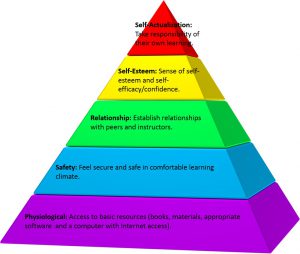
According to Maslow’s hierarchy of needs (1943), all individuals have the same basic needs: physiological, safety, belongingness and love, esteem, and self-actualization. As each need is met, the individual is satisfied but continues to seek the other needs. Poston later (2009) differentiated “being needs” from “deficit needs,” stating that “being needs” are internal and at the very top of the hierarchy of needs (see figure 1). He states that the “being needs” have nothing to do with the lower “deficit needs,” only with self-actualization. The example he offers is that this “top of the pyramid” is where one would be spiritual, corresponding to the internal concept of self-actualization. That is, a person’s ability and need to be spiritually active (their “being needs”) remains robust even when their abilities on other levels of the hierarchy are comparatively limited (their “deficit needs”).
A Place for All God’s Children
Individuals with disabilities have needs just like each of us. They are God’s children like the rest of us. The church can help with those needs, especially the top three levels of self-actualization, self-esteem, and relationships. Once a baseline has been established to determine the capabilities of the specific individuals involved, there are many opportunities to include people with disabilities in a congregation’s life. Just a few examples include serving as a lay speaker, guest preacher, sound board operator, greeter, or usher. Each individual can be evaluated to see where their spiritual gifts lie. It is to our benefit, to their benefit, and to the glory of God that we begin to think outside the-box and start helping these individuals become a part of a church community—and to know they are loved, respected, and matter!
 Dr. David Quel ’11 is a graduate of Pittsburgh Theological Seminary and Liberty University. He is trained as a pastor and family and marriage counselor. He is a father to three autistic sons, advises churches on creating welcoming environments for families with autistic members, including awareness of particular needs of autistic individuals and of the emotional and spiritual journeys of caregivers raising autistic children. He has appeared on the Spiritual Life and Leadership podcast and led continuing education events at Pittsburgh Theological Seminary and other institutions and churches on autistic inclusion in congregational contexts.
References:
Carter, Erik W. Including People with Disabilities in Faith Communities: A Guide for Service Providers, Families, and Congregations. Baltimore: Paul H. Brookes Publishing Co., 2007.
Carter, Erik W. “From Barriers to Belonging for People with Disabilities: Promising Pathways Toward Inclusive Ministry.” In Religion, Disability, and Interpersonal Violence, edited by Andy J. Johnson, J. Ruth Nelson, and Emily M. Lund, 25-44. Cham: Springer, 2017. https://doi.org/10.1007/978-3-319-56901-7_3. Geffner, Robert, Jacquelyn W. White, and L. Kevin.
Hamberger, Alan Rosenbaum, Viola Vaughan-Eden, and Victor I. Vieth, eds. Handbook of Interpersonal Violence and Abuse Across the Lifespan: A Project of the National Partnership to End Interpersonal Violence Across the Lifespan (NPEIV). Cham: Springer, 2022. https://doi.org/10.1007/978-3-319-89999-2.
Poston, Bob. “An Exercise in Personal Exploration: Maslow’s Hierarchy of Needs.” The Surgical Technologist 41, no. 8 (August 2009): 347-353.
Webb-Mitchell, B. (1993). God Plays Piano, Too: The Spiritual Lives of Disabled Children New York, N.Y.: Crossroad Publishing Company, 1993.
Read Next