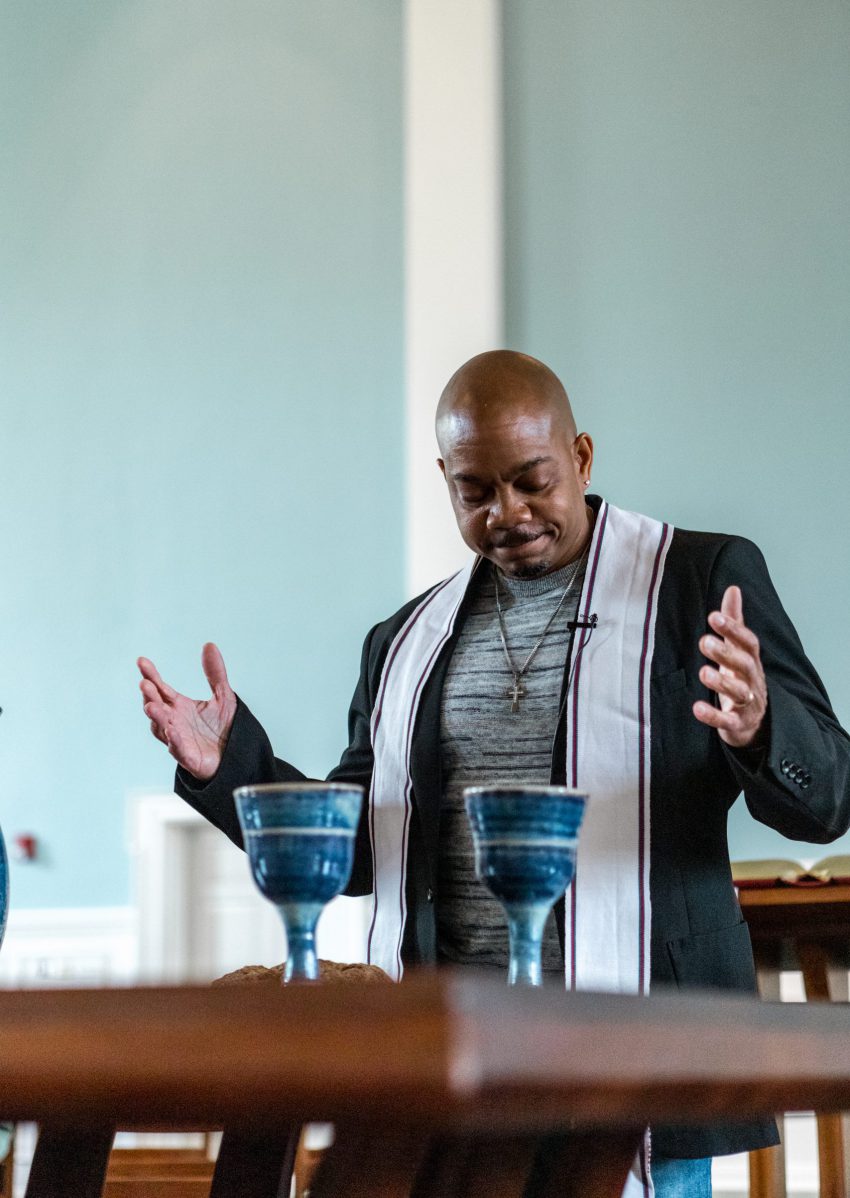

Above: The Rev. Ralph Lowe ’21, associate minister for congregational support and justice ministries of the Pittsburgh Presbytery, preaches during a chapel service at Pittsburgh Theological Seminary
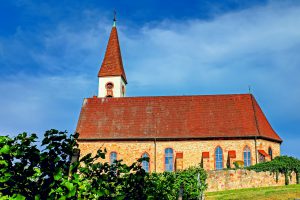
The Rev. Mark Blank ’17 pastors Second Congregational Church (Bennington, Vt.)—a rural church in an aging, former mill town, whose congregation he describes as “committed to extravagant welcome.” When the pandemic disrupted their traditional format of worship, Mark felt questions about how to do ministry well in the here-and-now intensify in his heart.
“I—along with everyone else—was plunged into a world in which so much was uncertain,” says Mark. “A question started to gnaw at me: In this kind of climate, where our practice is not to work toward truth together but to deny each others’ stories, how do we do church? How do we talk about this book (the Bible) with all these stories? How does the church answer what is happening now?”
A Pathway Forward
“I didn’t have answers, and trying to ‘preach my way through’ brought me to the limits of my faith,” Mark shares. “Finally, I had a summer sabbatical, and I felt a shift in my sense of call, a pull to explore how to translate faith into a secular context—how to reach people who haven’t stepped or won’t step into a church door, without it being about ‘getting them to join a church.’ The very week after my sabbatical ended, the Preaching in a Post-Christian Age Initiative was announced, and I immediately felt that it was my next step.”
Mark applied to the program, and he has now experienced multiple gatherings of his PPCAI cohort. “Hearing what others have been wrestling with has been really affirming,” he says. “It’s been wonderful to be with people working on these same questions from different contexts.” Though Mark’s cohort is still in the beginning stages of working with these key questions, his ministry has already begun to shift.
“These days, there’s sometimes a timidity around using the term ‘Christian,’ or identifying as a person of faith, or talking about the Bible,” he says. “I think an important step in ministry going forward—at least, in my context—will be to check in with our congregants’ (and our own) personal willingness to tell our stories. Part of my role as a preacher is to affirm to those in the pews that the Christian faith is their faith, not something the clergy owns. The stories of the Bible are their stories too, and I want to invite them to link the Christian story with their own stories. We don’t want to make it all about us, but at the same time, if the gospel has no impact on our lives, we’re just talking academics. Our context cries out for authentic faith, and embodying authentic faith has to start with the preacher.”
Mark says PPCAI “brought me out of my little bubble. I am hoping to discover ways to offer Sunday worship not just as a weekly social hour but as something that really fills a spiritual need in people. I, Mark, am not going to ‘save Christianity.’ My job is not to come up with a universal model that will work for everyone. My job is to walk alongside the people I’m called to in the best, most faithful way I can.”
“My job is not to come up with a universal model that will work for everyone. My job is to walk alongside the people I’m called to in the best, most faithful way I can.”
Join Us!
If the Preaching in a Post-Christian Age Initiative could benefit your ministry, the Seminary encourages you to apply! Applications for the 2026-2027 cohort are open through Feb. 28, 2026.
Apply to join a PPCAI cohort!
Funded via the Lilly Endowment’s Compelling Preaching Initiative, PTS’s Preaching in a Post-Christian Age Initiative exists to resource emerging, middle, and late-career pastors, church planters, and ministry leaders with the necessary sense of community, learning space, and tools to ideate preaching methods for sharing the gospel in the current post-Christian age. Each PPCAI cohort lasts one year, and cohorts gather on campus four times during the program.