

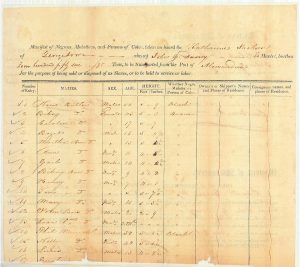
Public domain; source: U.S. National Archives and Records Administration
Even before the Rev. Ebony Grisom ‘25 joined Georgetown University as its director for Protestant life, there had been ongoing conversation there about how the University ought to reckon with its history as a Christian institution which owes its survival to practices of enslavement. In 1838, the Jesuit order charged with the University’s oversight sold more than 272 enslaved persons in order to save the institution financially. As the community’s Protestant chaplain and as a Black clergyperson, Ebony says the story of the University and the 272 “kept me up at night,” and the need for her Christian-identifying community to process its history was “alive and active in my personal and vocational imagination.”
A mentor encouraged Ebony to apply to Pittsburgh Theological Seminary’s Intergenerational Black Church Studies Doctor of Ministry cohort, and within her first semester, Ebony began to find resonance between the D.Min. program and her ministry at Georgetown. “There’s a virtual walking tour from the Slavery Memory of Reconciliation Working Group that highlights sites integral to the history around the 272,” she says. “I took it and thought, ‘Where’s the religion? As a Christian university, shouldn’t these reflections be informed by our faith? How could this experience be augmented?’ I thought of the stations of the cross, and designing a pilgrimage experience that integrated Scripture into a tour of on-campus locations significant in the story of the 272 became my D.Min. project.”

As the project took shape, Ebony started to see the tour as part of an awakening not only to the University’s history, but to its present as well. “We have our core collection of ‘Jesuit values’ displayed on banners around campus—academic excellence, faith that does justice, care for our common home, etc. If we’re all here in community, then in theory, we’ve all subscribed to these values. So it is appropriate for students, staff, and others to point out when we’re not doing what we say—especially at a religious institution, where we really believe these values matter. After a tour one research participant said, ‘I wanted these things—the Scripture readings reflecting our community’s stated values and the facts about our past—to go together, but I had to admit to myself that they didn’t.’ When we’re able to say out loud that our actions and our values have not aligned, we can become agents of interrupting, so we don’t carry that disintegrity into the future. It’s an invitation to do better, to be who we say we are.”
In recognition of Ebony’s work, the Seminary recognized her with the Faculty Prize in Public Theology and the Richard J. Rapp Memorial Award in Doctor of Ministry Studies. Raised by Covenant Community Presbyterian Church as a memorial for the Rev. Dr. Richard J. Rapp, the first director of the Doctor of Ministry Program at PTS, the Rapp Award provides copies of one or more outstanding doctoral papers to all ATS seminaries that have a D.Min. program.
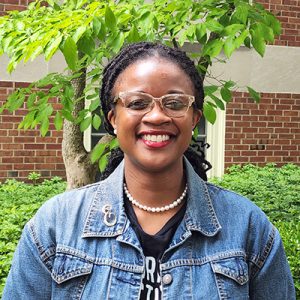 The Rev. Dr. Ebony Grisom ’25 is director for Protestant life and Protestant chaplain at Georgetown University, where she also co-chairs the “Let Freedom Ring!” initiative. She is ordained in the American Baptist Churches USA and has served in congregational ministry , faith-based anti-poverty work, and as a Godly Play trainer. She was also co-convener of the National Council of Churches of Christ in the USA’s Convening Table on Joint Action and Advocacy for Justice and Peace. She holds degrees from the University of North Carolina at Charlotte, Providence College, Duke Divinity School, and Pittsburgh Theological Seminary.
Read Next


1 thought on “Faith With Integrity—Knitting Values and Actions Together”