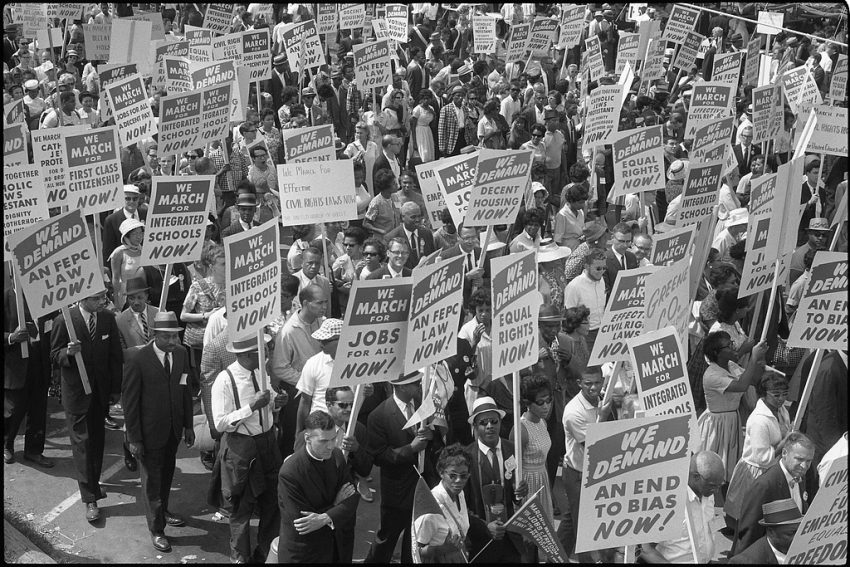

Above: Demonstrators marching in the street holding signs during the March on Washington, 1963. Photograph by Marion S. Trikosko, Aug. 28, 1963. Library of Congress Control Number 2013647400.
The evidence of faith has always been made known, even when we didn’t recognize it.
For generations, we’ve been singing “Lift Every Voice and Sing,” a song full of faith; faith shaped by the lessons of a dark past. Evidence is never something imaginary; it is something that has already occurred. A clue, an artifact, a marker that helps prove a point. Evidence helps us understand the present and guides us toward the future. Evidence is something we can stand firm on.
Faith of Our Ancestors, Sustained by the Spirit
When we look back, we see a faith carried by a people who have overcome time and time again: from enslavement to the Civil War, from Jim Crow to the Great Migration, from segregation to Civil Rights to continued civil unrest. Time and time again we have overcome. We have stood firm. We have lifted our voices and our bodies because we have witnessed the faith of our ancestors prevail. That faith was and is undeniably rooted in Christ. While some have tried to distort, misuse, or weaponize the Word of God, our faith has always been moved by the Spirit.
It was the Spirit who sparked a moral compass inside, leading so many to freedom through the night, the Spirit who strengthened us as we watched strange fruit hang from Southern trees, the Spirit who birthed freedom songs, hymns, and chants that carried us through the most dire of times. That, to me, is evidence—evidence that God is a God of the oppressed, a God who does not abandon but abides. It is the Spirit who sustains us, not our circumstances.
It was the Spirit who sparked a moral compass inside, leading so many to freedom through the night, the Spirit who strengthened us as we watched strange fruit hang from Southern trees, the Spirit who birthed freedom songs, hymns, and chants that carried us through the most dire of times.
We Are Still Here—in Glory and Might, Embodying Faith
The work of the Cross was and remains evidence that in Christ, we all belong. The resistant blood of the past, the resilient blood of the past, and the triumphant blood shed at the Cross all run through our veins today. We have no choice but to prevail, because the evidence has shown that despite everything that has tried to stop us, we are still here. Still here striving to realize a dream deferred but not denied. Still here on the forefront. Still here carrying a joy the world cannot take because the world did not give it. Still here in all our glory and might.
 So many times, we have been placed in situations that demanded resilience. We had no option but to rise above every challenge. And as Assata Shakur reminded us, it has always been our duty to fight for our freedom. But I wonder: What would the world look like if we no longer had to fight? If we no longer had to be resilient? If we were finally allowed not just to survive but to simply live?
What would the world look like if we no longer had to fight? If we no longer had to be resilient? If we were finally allowed not just to survive but to simply live?
What does faith look like when the world feels unsteady beneath our feet? For many, faith is imagined as quiet assurance; something internal, tranquil, or even passive. But history, lived experience, and the stories of countless communities tell a different truth. Faith often becomes most visible, most embodied, and most transformative precisely when circumstances demand resistance and resilience.
Collective Courage, Spiritual Imagination, and Determination to Act on Another’s Behalf
Liberation is rarely a single moment. It is a long road paved by collective courage, spiritual imagination, and the determination to act on one another’s behalf. Importantly, liberation is not only freedom from something but also freedom for something: the flourishing of communities, the restoration of relationships, the dignity of each person, and the creation of systems that honor life rather than diminish it. Faith as evidence, resistance, and resilience helps build that road. It enables people to move toward liberation long before its destination becomes clear. Whether we face personal challenges, societal upheaval, or global uncertainty, the interplay of faith, resistance, resilience, and liberation remains profoundly relevant.
Faith . . . enables people to move toward liberation long before its destination becomes clear.
As we anticipate this year’s Kelso Lecture with the Rev. William H. Lamar IV, may we use the time not only to listen, but to reflect: Where is faith calling you to notice evidence of possibility? What forms of resistance or resilience might you already be practicing, perhaps without even naming them? And how might each small act of faith (yours, mine, ours) help shape a more liberated future?
The road to liberation is long, but faith continues to illuminate it.
Register now for the 2026 Kelso Lecture:
“For the Joy Set Before Us: Reflections on the Source of Resistance and Liberatory Praxis”
with the Rev. William H. Lamar
March 12, 6:00 p.m., at Mt. Ararat Baptist Church (271 Paulson Ave, Pittsburgh, PA 15206).
Free and open to the public. A concert by the Hampton University Concert Choir will follow the Kelso Lecture.

Kelso Lecture Description:
Justice organizers in certain traditions ask a key question: “What makes you angry?” Anger can motivate us to co-create with the Divine a more just and beautiful world, yet it is often more suited to tearing down than building up. If anger is the sprinter in the struggle for shared flourishing, joy is the marathoner. This lecture will explore the tradition of joy and how it energizes and sustains the transformation of our world. The Scripture for the lecture is Hebrews 11:1.
 The Rev. Dr. April Roebuck ’14/’19 is an associate minister at Mt. Ararat Baptist Church, where she was ordained by the Rev. Dr. William H. Curtis in 2012. She has preached widely at churches within and beyond Baptist traditions and spoken at organizations across Pittsburgh. Rev. Dr. Roebuck has extensive experience as an information technology professional, holding positions such as compliance analyst at PNC, systems analyst at UPMC, senior business analyst at Dollar Bank, and business systems analyst at Vitalant. She holds degrees from ICM School of Business (AS, networking and computer management), Point Park University (BS, information technology), and Pittsburgh Theological Seminary (MDiv, DMin, missional leadership). Rev. Dr. Roebuck is chairs the Metro-Urban Institute advisory council at Pittsburgh Theological Seminary.