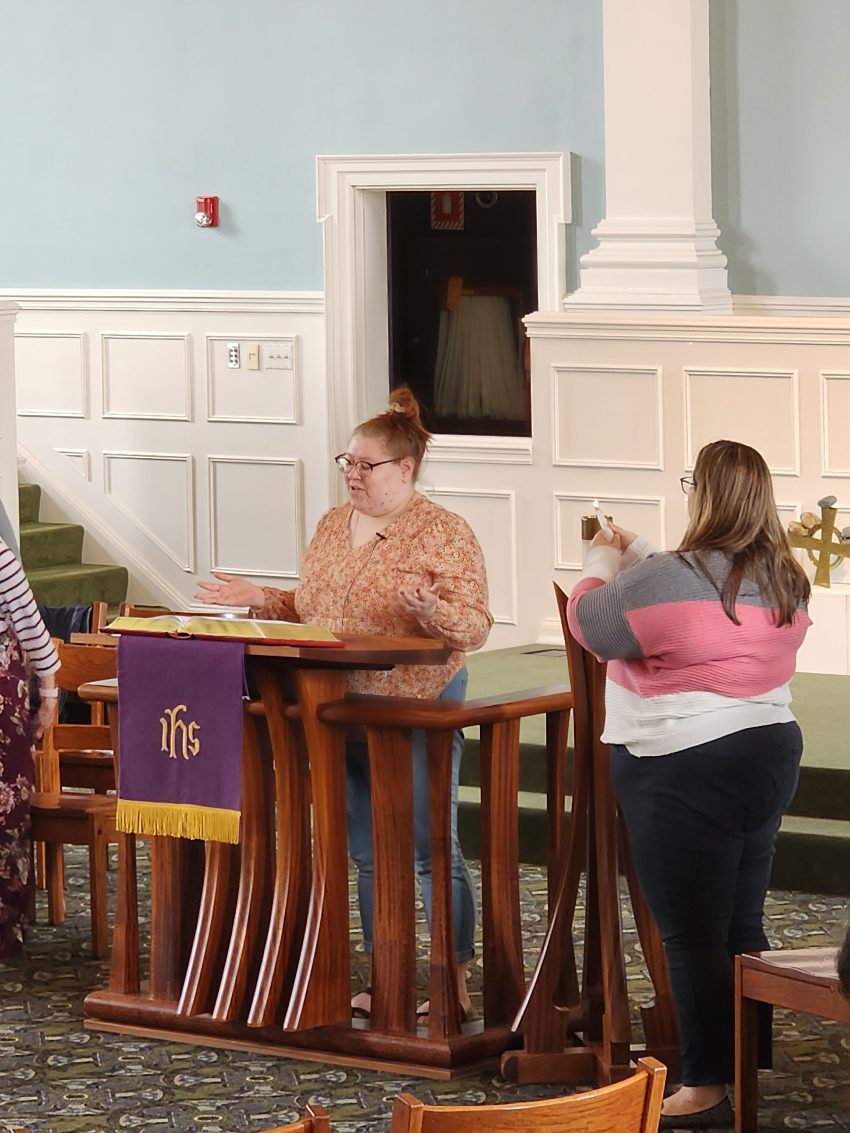

Above: Emma Kate Lander ’25 and Stephanie Backus ’24 help to lead a service at Hicks Memorial Chapel (PTS campus).
My experience as a clergywoman has always been related to my experience as a woman.
I remember one of the first times I articulated a desire to be a pastor. I was in first grade, and to be fair, it was the only career modeled for me as the daughter of two United Methodist pastors. My teacher, however, told me that was impossible because I was a girl.
That was 1997, after about a century of the ordination of women in mainline Protestant traditions.
Intergenerational Guidance Amidst Bias
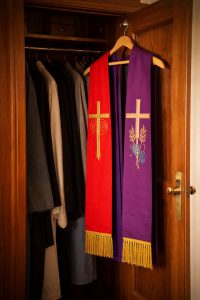 My mother, the Rev. Deborah Ackley-Killian, started working as a student pastor in Pittsburgh in 1986, graduated from Pittsburgh Theological Seminary in 1988, and was ordained in The UMC in 1990. I sat down with her recently to talk about her experiences as a clergywoman from the 80s until now. We talked about the advice I received over the years and what that advice reveals about the reality of ministry as a woman and how so much has changed and so much has stayed the same between her experience and mine.
Being the daughter of a clergywoman meant that I had access to troves of advice about being a clergywoman, not only from my mother but from other clergy in her orbit. I heard advice on how to navigate the ordination process since women must work twice as hard to gain respect and authority. I was taught to never have a pen in my hand at the beginning of a meeting if I am the only woman or else I will be asked to be secretary. I was taught how to respond with grace but conviction regarding my call if I am told to consider children’s ministry instead of ordained ministry. These small practical pieces of advice reveal how hard authority is won for women while it often seems to be easily handed over to our male colleagues. This advice points to the truth that clergywomen frequently must justify their existence as clergywomen, sometimes even literally when confronted with those who continue to oppose the ordination of women.
But practical advice can also reveal the violence of sexism and the risk of being clergy. I have received advice and heard stories about carrying pepper spray to meetings or even in your robe while preaching and leading worship. I’ve been taught to keep my safety in mind about where and when to schedule meetings.
Change Has Happened, Yet More Is Needed
 My mother also asked me if I wished her generation had done anything more or anything differently for my generation of clergywomen.
Because of the pioneering work of clergywomen before me, things are easier for me and my peers. Rarely is one of us the first woman pastor in a congregation or ministry setting. We are not as often confronted with those opposed to the ordination of women or with blatant sexual harassment. That does not mean, however, the misogyny and sexism in the Church is over and gone. It’s more subtle now. I still call on that advice that I received frequently, which means I am still confronting the same root issues.
But this is obviously not only a problem in the Church. There are real challenges of being a woman in many professional fields. And the Church does not exist in a vacuum but is also susceptible to the broader workings of patriarchy.
Neither is my experience of being a woman in ordained ministry only a challenge. There is so much joy in seeing young girls see themselves represented in the pulpit. There is a hard-won joy when those opposed to the ordination of women open themselves to the moving of the Spirit and are transformed into cherished friends and allies.
Called as a Woman
 My ministry, including my call to ministry, cannot be separated from my identity as a woman. I move through this world in a female body and experience this world as a woman, which informs my understanding of power and how it functions. In turn, this understanding of how power operates is inherent to my ministry, informing the way I read Scripture, the way I preach, the way I lead and pastor.
Moving through our world as a woman exposed me to experiences of marginalization, a lack of safety, and also immense joy at deep, care-filled relationships. Bringing all these experiences into my ministry means that I am able to offer new perspectives and connect with different experiences of the people to whom I am ministering.
Bringing our experiences into our ministry is not unique to clergywomen, of course. But we do not all experience the machinations of power in the same way or to the same extant. It is our responsibility, regardless of identity, to consider the ways our experiences inform our ministry, what ministerial blind spots we may have due to those experiences, and how our ministry perpetuates the harmful systems of this world or opens our eyes and imaginations to that to which God is calling us.
Taking Up the Baton
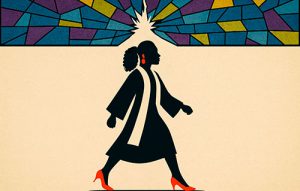
I now find myself in the mentor position at times as I encourage the younger women I know who are going through the ordination process. In this position, I am pondering the same question my mother asked me: Are we doing enough for the generations coming after us? I wonder if I am doing enough to make things easier for these women and if I am offering the right advice as they bump up against the stained-glass ceiling. I pray that I am like the women who came before in ministry and paved the way with courage, resilience, and joy in their callings and ministries.
Interested in exploring more about women’s ordination, particularly in The United Methodist tradition? Join us in person or online for this year’s Albright-Deerling lecture, “Celebrating 70 Years of Women’s Ordination in the Methodist Tradition,” March 3, 2026.
Register for the 2026 Albright-Deering Lectures.
The Rev. Stephanie York Arnold, general secretary for The General Commission on the Status and Role of Women of The United Methodist Church, and the Rev. Dr. Emily Nelms Chastain, assistant professor of Christian history and Methodist studies at Perkins School of Theology at Southern Methodist University, will present the 2026 Albright-Deering Lectures.
- Lecture 1: She Preached Anyway: How Methodist Women Turned Print and Polity into Power (1919-1956)
- Lecture 2: Still Called, Still Climbing: Clergywomen Today
- Lecture 3: The Next Itineration: Envisioning Women’s Leadership Together
Learn more about free lectures.

The Rev. Grace Killian (PTS Miller Summer Youth Institute graduate ’08) is an ordained elder in the Western Pennsylvania Annual Conference. She currently serves as the connectional ministries associate at the Connectional Table of The United Methodist Church, which is tasked with discerning and articulating the vision of The UMC. Prior to her ordination, Rev. Killian was a global mission fellow for the United Methodist General Board of Global Ministries, serving in Bethlehem, Palestine/Israel. She has also worked at Harvard-Epworth UMC and the Memorial Church at Harvard University. She earned her M.Div. from Harvard Divinity School and M.A. in law and diplomacy from the Fletcher School of Law and Diplomacy at Tufts University. Rev. Killian is a daughter of Mt. Lebanon UMC and maintains her charge conference relationship there. She currently resides in Cambridge, Mass., and worships at Harvard-Epworth UMC, where she leads the Liberation Covenant Group.