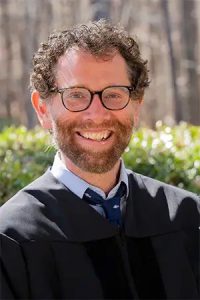

At Pittsburgh Seminary, we seek to participate in God’s ongoing mission in the world by seeing and getting to know people as our neighbors. Challenged by Jesus’ parable of the Good Samaritan and inspired by Mr. Fred Rogers ’62, who sang, “I have always wanted to have a neighbor just like you!”, I am writing this blog to introduce you to some of my neighbors—students in our Doctor of Ministry (D.Min.) Program, for which I am honored to serve as the director. They work with diverse populations, whom they have come to see as neighbors and care for lovingly. I hope by the end of this series, you will get to know our Doctor of Ministry students, their ministries, as well as see those whom they serve as siblings in Christ, as neighbors near and far.
I’d like to introduce you to my neighbor Joanne Spence. Joanne was born in England and immigrated to Australia, where she spent her childhood and early adult years before meeting her husband, Doug, and immigrating to the U.S. Joanne is a yoga instructor and the author of Trauma-Informed Yoga: A Toolbox for Therapists. In May 2024, Dr. Spence graduated with her Doctor of Ministry degree in Creative Writing and Public Theology. She is the recipient of the PTS Alumnae/i Association’s Fred McFeely Rogers Award for Creative Ministry (2023). — The Rev. Dr. Donna Giver-Johnston
Serving Neighbors in Times of Pain
 As a resident of North Point Breeze, an east-end neighborhood in the City of Pittsburgh, I live just a mile from Fred Rogers’ actual neighborhood. As a two-time graduate of Pittsburgh Theological Seminary (M.A., D.Min.), Fred’s alma mater, I feel the kinship deeply. At the Seminary we even celebrate National Cardigan Day—something I suspect Fred would have enjoyed immensely, though perhaps he’d be a little bemused by our fascination with his sweaters.
My earliest service to my neighbors came as an in-home family counselor. In truth, I was a court-ordered therapist: if the judge said a family needed therapy, I worked for the agency that provided it. I would show up at a doorstep with my earnest self and my video camera. The work was difficult and sometimes heartbreaking. At best, families gained support and skills that kept children safely at home or reunited them after separation. At worst, I accompanied a police officer and a child protection worker to legally remove a child from their home.
In 1998, my path shifted abruptly after a serious car accident. Married with two young children, I spent two years struggling to regain my health. Eventually, I stumbled into yoga. To my surprise, it made sense to my body in a way nothing else had. Just three days after completing my first teacher training (an unusual beginning, as I taught before I really practiced), I was pain-free for the first time in two years. To me, this was like receiving a baton: if yoga could help me heal, perhaps it could help my neighbors too.
Inhabiting the Body as a Path Toward Healing
 Over the years, I opened several yoga studios in my neighborhood. Yet after about five years, I felt a pull back to the people I had served as a social worker. Two opportunities allowed me to do just that. First, I founded Yoga in Schools, a nonprofit designed to bring yoga into classrooms and supported by local foundations. To date, the program has served more than 1,000 teachers and 24,000 students nationwide. I still smile when a child spots me in the grocery store—“Hey, Mrs. Yoga!”—and drags a parent over for a quick Tree Pose in the cereal aisle.
The second opportunity came when I became the first yoga therapist at Western Psychiatric Institute and Clinic, a 250-bed inpatient psychiatric hospital (one of the largest in the U.S.) in Pittsburgh’s Oakland neighborhood. As part of the Creative and Expressive Arts Team, I led therapeutic yoga groups for people in acute stages of mental illness—depression, anxiety, bipolar disorder, schizophrenia, PTSD. It was humbling work. Even after a decade, it still felt like a small miracle to watch someone’s breath slow, their shoulders soften, and a bit of quiet emerge in a turbulent mind. It was in this environment that I learned the power of chair yoga and gentle, breath-centered practice.
As I deepened my work, I came to understand more of the neuroscience behind what I was witnessing—the anatomy of the nervous system and how simple practices could foster regulation and healing. Translating complex science into bite-sized, accessible tools became part of my vocation, making yoga approachable for anyone willing to try.
Encountering God in Embodied Practices
 To my surprise, yoga also led me back to theology. Though I had come to faith as a child, it was on the yoga mat that I most tangibly felt the presence of God. My understanding of faith deepened: if God came to us in a body, in Jesus, then bodies matter. What we do with them and how we care for them matters. While at seminary, I wrote In Habit Your Body, a middle school contemplative curriculum that I piloted at Pittsburgh Urban Christian School. Later, I adapted it for young adults to help them discover that faith is lived not only in belief but in embodied practice.
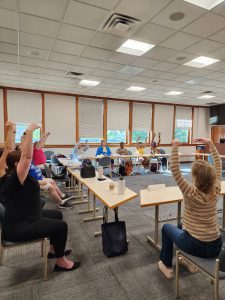
It may sound unusual to equate “neighbor” with the people I served as a counselor, yoga teacher, or therapist. Every person I counseled, every student I taught—whether in a yoga studio, a school classroom, a hospital unit, or even a juvenile detention center—was my sister, my brother, my friend. I no longer saw a separation. They were my neighbors. It was as if I was them, and they were me. Different circumstances, yes, but fundamentally the same. This realization became both the crucible and the conviction of my path forward—the crucible, in that it tested and refined me, and the conviction, in that it gave me a guiding belief I could not set aside.
After all, the word yoga means union. Union with oneself, with our neighbors, and ultimately with God. Every time I step onto the mat or invite others into practice, I am reminded that connection is both the gift and the goal: to inhabit our bodies with compassion, to recognize the sacredness of one another, and to rest in the presence of a God who holds us all together. That sounds like good news to me. In that sense, I find myself echoing Mr. Rogers’ enduring question: Won’t you be my neighbor?
 Dr. Joanne Spence ’18/’24 is an author, spiritual director, and certified yoga therapist whose work explores what it means to love our neighbors—near and far—through practices of presence, care, and embodied attention. With a background in clinical social work, she has spent more than two decades developing trauma-informed, accessible practices that attend to the whole person: body, mind, and spirit. She is the founder of Yoga in Schools and Urban Oasis Pittsburgh and was the first yoga instructor at Western Psychiatric Institute and Clinic in Pittsburgh, one of the largest inpatient psychiatric hospitals in the United States. Across healthcare, educational, and faith-based settings, her work has focused on accompanying people living with anxiety, depression, trauma, chronic pain, and profound life transitions. Joanne is the author of Trauma-Informed Yoga: A Toolbox for Therapists and co-author (with Catherine Cook-Cottone) of Trauma-Informed and Trauma-Responsive Yoga Teaching: A Universal Practice. Her current writing and teaching draw deeply on Christian contemplative traditions, inviting prayer that engages the whole person and honors vulnerability, limits, and interdependence. She regularly leads retreats and workshops in churches, seminaries, healthcare environments, and professional trainings. Her forthcoming book, How to Die Well: A Practical Guide for the Living, will be published in May 2026. In 2023, Joanne received the Pittsburgh Theological Seminary Alumnae/i Association’s Fred McFeely Rogers Award for Creative Ministry. She holds degrees from James Cook University (BSW) and Pittsburgh Theological Seminary (MA, DMin), along with certification in spiritual direction from the Pneuma Institute.
Read Next