Doctor of Ministry in Bridging Divides: In Church, Community, and Country
Join the Bridging Divides Cohort
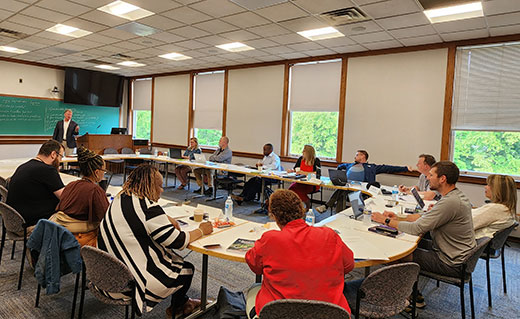
Designed in response to the current polarizing political and cultural climate, Pittsburgh Theological Seminary’s (PTS) three-to-four-year hybrid Doctor of Ministry (D.Min.) in Bridging Divides: In Church, Community, and Country degree program explores the ways the Church can be a healing presence in a fractured world. Ministers, religious leaders, and community members come together to learn theological reflection techniques, conflict transformation practices, and strategies for preaching, care, and leadership that honor both our differences and shared identity as children of God.
History of Division: Answer the Call to Lead Reconciliation
Throughout time, and even within the Church, division has always existed. From the Great Schism to the Reformation, from the Civil War to the Civil Rights Movement, and from debates in the early church to current-day political polarization, faith communities have wrestled with how to embody unity in Christ while engaging the differences that exist between believers. In Galatians 3:28, Paul addresses tensions around the inclusion of Gentiles in the first-century Church, proclaiming, “There is no longer Jew or Greek, slave or free, male and female, for all of you are one in Christ Jesus.”
At PTS, we invite students to confront the forces that separate us while learning to lead with hope, humility, and practical wisdom. As Howard Thurman once wrote, “When I look at myself through your eyes … the wall that separates and divides will disappear.” That vision shapes the Bridging Divides focus: learning to be present with others across divides, so the Church may better witness the reconciling love of Christ. Students will:
- Learn pastoral strategies to lead amid polarization and conflict
- Practice theological reflection rooted in unity and justice
- Engage theologies of place and neighborliness
- Explore historical and present-day divisions in the Church and culture
- Develop skills in preaching, teaching, and communal care
- Join a cohort of spiritually grounded, socially conscious ministry and community leaders

Hear from Our Faculty
Who Should Join the Bridging Divides Cohort
Some of the most important ministry happens in the hardest places—divided churches, polarized communities, or neighborhoods grappling with change. Graduates with a Doctor of Ministry in Bridging Divides degree serve as pastors, community leaders, and nonprofit professionals who use practical strategies to lead through disagreements, cultivate unity, and help people move forward together. They directly apply communication and conflict resolution skills in contexts where reconciliation, listening, and healing are needed.
Program Details
Review the application steps, tuition information, and curriculum for the Doctor of Ministry in Bridging Divides program.
How to Apply
With limited space in each Bridging Divides cohort, we encourage prospective students to apply early. Pittsburgh Theological Seminary accepts D.Min. degree applications on a rolling basis, and a waitlist is available if the cohort reaches capacity. Explore the D.Min. degree admission requirements to start your application.
Have questions about applying to the Doctor of Ministry program? E-mail the admissions team at or call 412-924-1365.
Application Deadlines
Priority Deadline: Dec. 5, 2025
Final Deadline: April 17, 2026
Prerequisites
For program eligibility, applicants must hold a Master of Divinity (M.Div.) or an accredited master's degree in a field related to their ministry context.
Cost and Financial Aid
We’ve structured tuition for the Bridging Divides program to reflect our commitment to church leaders by keeping the cost of attendance lower than most doctoral programs. Pittsburgh Theological Seminary also offers financial aid and scholarship opportunities for eligible students earning their D.Min. degree.
Note: Federal loans are not available for this program.
Course Topics
In the Bridging Divides: In Church, Community, and Country focus area, courses span the disciplines of Bible, theology, missiology, ethics, preaching, and pastoral care. Students examine strategies for responding to conflict and division in constructive and imaginative ways. Courses include the following, among others:
Bridging Divides: An Introduction
The purpose of this course is to launch our conversation about the general themes that will occupy the cohort throughout the next several years. These include the complex realities of division and polarization in society and in the church; systemic patterns of conflict in organizational life; the unique demands leaders face in conflicted environments; and reflection on theological and biblical resources that speak into these realities. Additionally, the course will help students and faculty establish collegial working relationships with each other so that a robust learning community might be established.
Research Methods
Explores research methods necessary for the academic work of the program; teaches basic ethnographic or other appropriate research methods. Gives students the opportunity to explore a research question that might become the basis for a D.Min. project.
Seeking Unity in a Divided Church
This course introduces hospitality as a theological concept permeating texts within Christian canons (Old Testament, New Testament, and Apocrypha/Deuterocanon) and adjacent texts (Second Temple Jewish texts, Apostolic Fathers, other early Christian texts). The Apostle Paul inherited this tradition and engaged it in ways that are significant both for earliest Christian history and for the church in the twenty-first century. This course will prioritize textual and historical analyses, but learning experiences and assessments will also include the embodiment of theologies of hospitality in contemporary contexts.
Rethinking Church: Ecclesiology
This course will take the strange notion of our “unity in Christ” as a starting point from which Christian communities may counter the divisions within the culture and among themselves. Thinking about the church not as a voluntary organization but as a community constituted by God, we will explore the relationships between God’s mission in the world, the church, and salvation, challenge denominational divides as acceptable or inevitable ways to express Christian identity, and seek alternative ways for a Christian common life within our local communities.
Deliberative Dialogue as a Practice of the Church
Participants will engage with a variety of perspectives, leaving with the confidence and skills to approach conflict empathetically and create constructive change.
Plunging into the Neighborhood
This course will take process of communal discernment into a journey of discovery in the neighborhood by using the postures, habits, and practices of community exegesis, by deep listening to the neighbor, building relationships, and forming bi-cultural bridge communities as an integral part of discerning the congregation’s participation in God’s mission in their specific context.
Preaching and Leading Worship in Conflicted Communities
“Worship is at the very heart of the church’s life. All that the church is and does is rooted in its worship. The community of faith, gathered in response to God’s call, is formed in its worship. Worship is the principal influence that shapes our faith, and is the most visible way we express the faith.” (Book of Common Worship of the Presbyterian Church USA). Given the centrality of worship, this course will engage the theology and practice of worship, attending to each of its movements: Gathering, Proclaiming, Responding, Sealing, and Bearing Out. With careful consideration of our contexts in which worship is rooted, we will discuss the conflicted communities of which we are a part or of which we have knowledge. We will experience and craft liturgies of lament and healing, confession and reconciliation. After listening to sermons with messages of healing, hope, and transformation, students will preach a sermon or offer a proclamation with a particular conflicted context in mind. In so doing, they will learn how to lead worship and preach in conflicted communities.
Communal Care Across Divides—Final Proposal Lab
This course explores the challenges of pastoral care and leadership in communities that are experiencing conflict or tension due to important issues arising in their midst. The course presents reflective, thoughtful leadership as a form of care, and encourages students to explore their own gifts and limitations as leaders in conflicted contexts.
Current Cohort Schedule
| Date | Course |
| June 8-12, 2026 | Bridging Divides: An Introduction Leanna Fuller, Ph.D. (Faculty Mentor) Joan Marshall Professor of Pastoral Care |
| June 15-19, 2026 | Research Methods Donna Giver-Johnston, Ph.D. Director of the Doctor of Ministry Program |
| Jan. 18-22, 2027 | Rethinking Church Edwin van Driel, Ph.D. Directors' Bicentennial Professor of Theology |
| Jan. 25-29, 2027 | Deliberative Dialogue Leah Schade, Ph.D. Associate Professor of Preaching and Worship |
| June 14-18, 2027 | Seeking Unity in Divided Church Rafael Rodriguez, Ph.D. Professor of New Testament |
| June 21-25, 2027 | Engaging Difference in Communal Contexts R. Drew Smith, Ph.D. Henry L. Hillman Professor of Urban Ministry |
| Jan. 3-7, 2028 | Plunging into the Neighborhood Scott Hagley, Ph.D. W. Don McClure Professor of World Mission and Evangelism |
| Jan. 10-14, 2028 | Preaching and Leading Worship in Conflicted Communities Donna Giver-Johnston, Ph.D. Director of the Doctor of Ministry Program |
| June 12-16, 2028 | Neighborhood Ethic of Care Clarence Wright, D.Min. Fred Rogers Fellow in Theology and Ministry |
| June 19-23, 2028 | Communal Care Across Divides—Final Proposal Lab Leanna Fuller, Ph.D. (Faculty Mentor) Joan Marshall Professor of Pastoral Care |
Student Learning Outcomes
Students in this focus will:
- Integrate theological and scriptural knowledge with their cultural contexts.
- Richly describe and analyze cultural contexts to recognize, frame, and respond to crucial issues arising in their ministry.
- Develop enhanced leadership capacities oriented toward effective ministry.
- Draw upon theological resources and practices to reinvigorate and deepen their vocational callings.
- Demonstrate the ability to reflect on their own social location (e.g. gender, religion, nationality, race, etc.).
- Analyze and describe the effects of trauma on individuals and communities and how it undermines human flourishing
- Ethically integrate the psychological sciences with theology, scripture, and other components of religious life to promote psycho-spiritual health and wholeness
Learn More About Pittsburgh Theological Seminary’s Bridging Divides: In Church, Community, and Country Program
Now more than ever, the Church needs leaders who can bridge differences and guide communities toward reconciliation with grace and understanding. If you feel called to this work, apply to Pittsburgh Theological Seminary's hybrid Doctor of Ministry in Bridging Divides degree program.